
Description
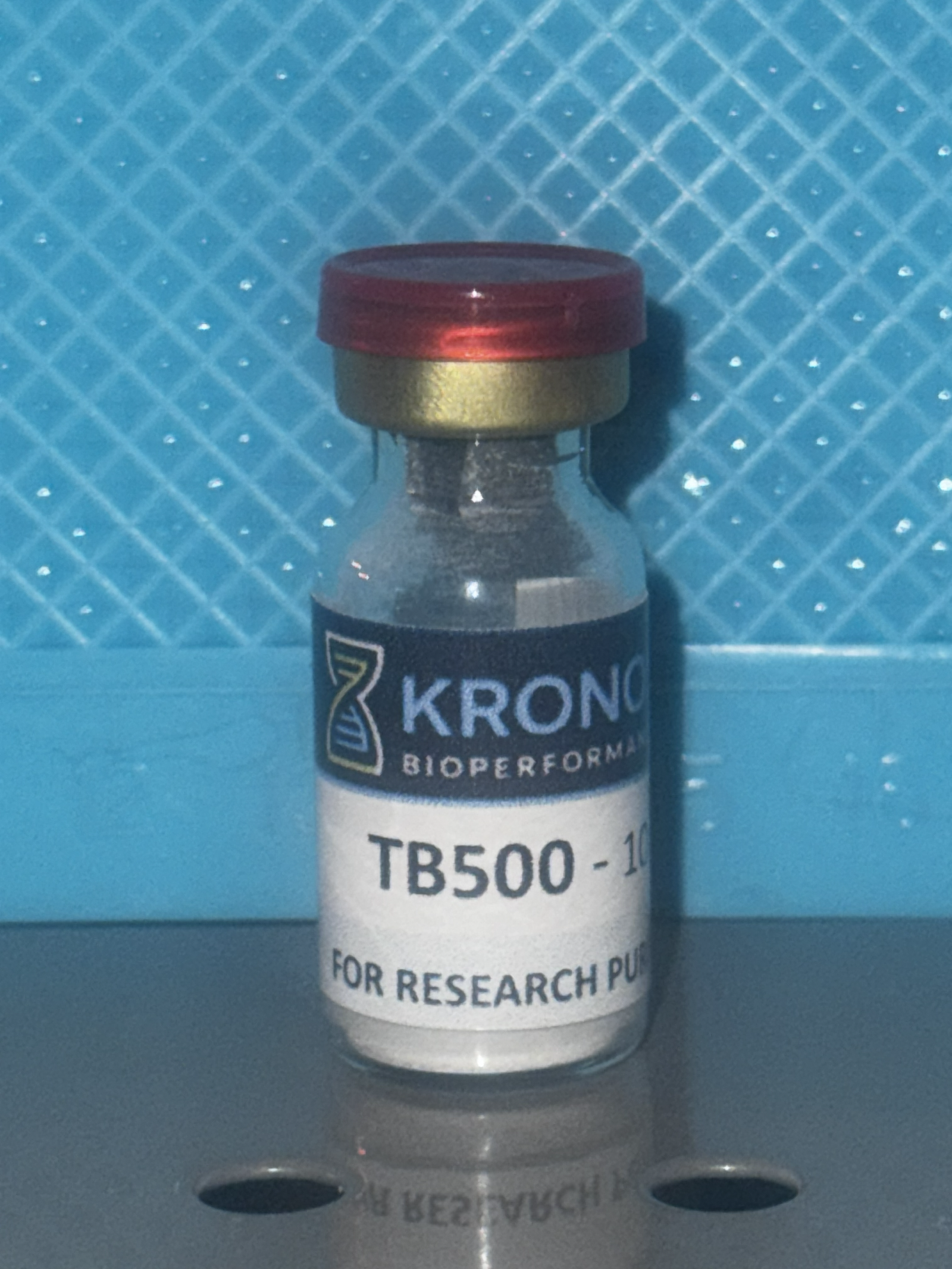
What Is TB-500?
TB-500 is a synthetic peptide fragment derived from Thymosin Beta-4 (Tβ4), a naturally occurring peptide found in high concentrations throughout the body, particularly in tissues involved in repair and regeneration. Thymosin Beta-4 plays a key role in cell migration, tissue remodeling, and wound healing.
TB-500 was developed to isolate and concentrate the regenerative signaling properties of Thymosin Beta-4 while allowing for broader systemic distribution in research applications. It is not a hormone and does not directly stimulate growth factor release; instead, it functions as a cell-repair and mobility peptide.
What Does TB-500 Do?
TB-500 is best known for its role in musculoskeletal repair, injury recovery, and tissue regeneration. It has been studied for its ability to:
-
Accelerate healing of muscles, tendons, and ligaments
-
Improve joint and connective tissue resilience
-
Support recovery from acute and chronic injury
-
Promote tissue remodeling and flexibility
Because of its systemic distribution, TB-500 is often discussed in sports medicine and orthopedic research contexts.
How Does TB-500 Function in the Body?
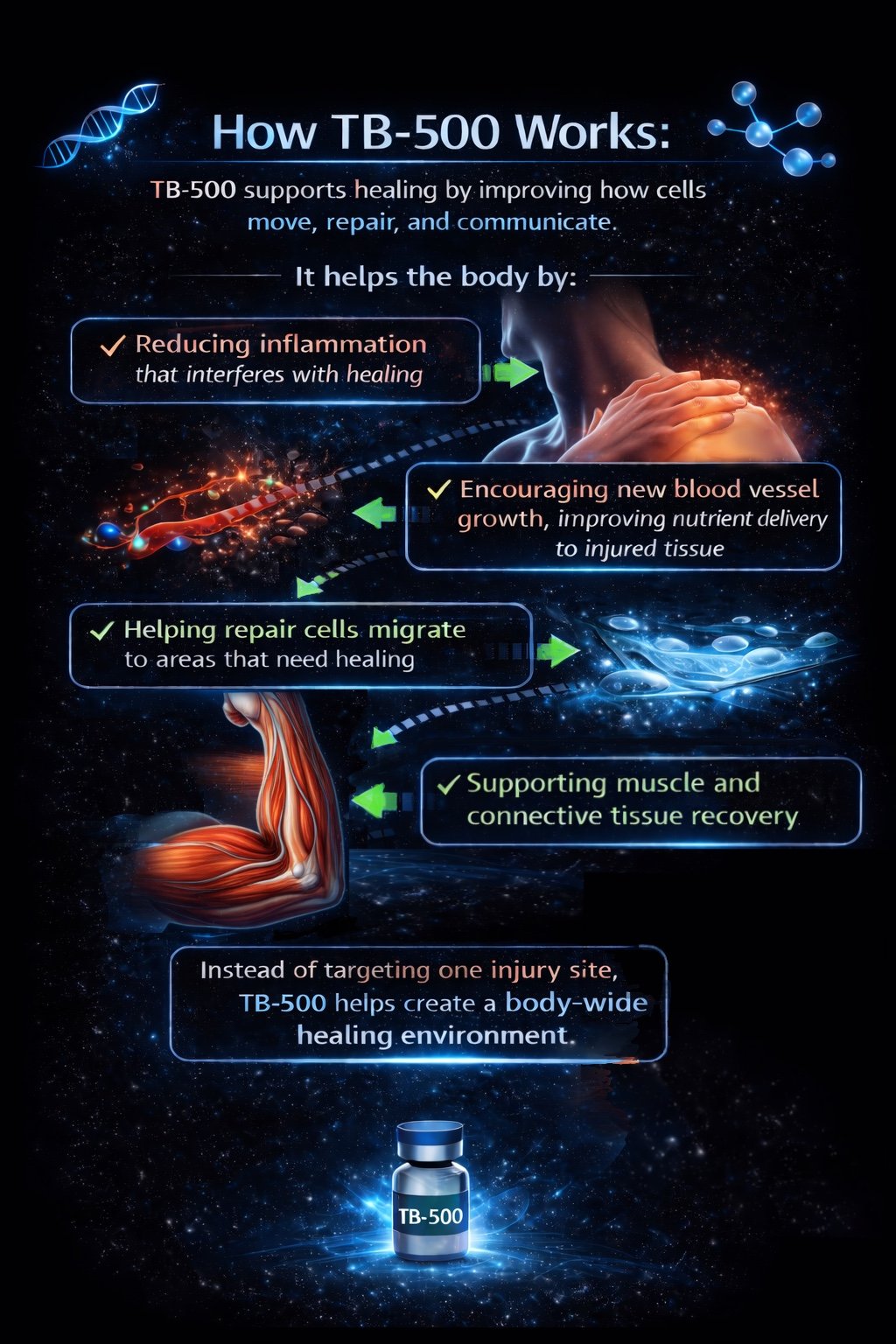
TB-500 exerts its effects through several core biological mechanisms:
1. Actin Binding & Cell Migration
TB-500 regulates actin, a structural protein critical for cell movement. By modulating actin dynamics, TB-500:
-
Enhances cell migration to injury sites
-
Supports tissue remodeling and repair
2. Angiogenesis Support
TB-500 promotes the formation of new blood vessels, improving blood flow, oxygen delivery, and nutrient transport to healing tissues.
3. Inflammation Modulation
It helps regulate inflammatory signaling, reducing excessive inflammation while supporting the healing process.
4. Tissue Remodeling & Flexibility
TB-500 supports extracellular matrix reorganization, contributing to improved tissue elasticity and functional recovery.
What Do Studies Show?
Preclinical research indicates that TB-500:
-
Accelerates healing of muscle, tendon, and ligament injuries
-
Improves recovery outcomes in connective tissue damage models
-
Supports angiogenesis and tissue regeneration
-
Demonstrates a favorable safety profile in animal studies
While human clinical data are limited, the underlying research on Thymosin Beta-4 provides a strong mechanistic foundation for TB-500’s regenerative effects.
Overall Benefits of TB-500
-
Supports rapid tissue repair and recovery
-
Enhances muscle, tendon, and ligament healing
-
Promotes angiogenesis and tissue remodeling
-
Improves flexibility and functional recovery
-
Systemic regenerative signaling without hormonal effects
TB-500 is often positioned as a foundational musculoskeletal repair peptide, frequently stacked with BPC-157, Cartalax, or GH-axis peptides in recovery-focused research frameworks.
Important Regulatory Note
TB-500 is not FDA-approved for medical use in the United States and is sold as a research peptide only. This information is provided for educational and informational purposes and is not intended to diagnose, treat, cure, or prevent any disease.
TB-500 Fragment (17-23) is a research peptide consisting of a short amino acid sequence derived from the actin-binding region of Thymosin Beta-4. It has been shown in preclinical studies to regulate cell migration, angiogenesis, and cytoskeletal organization through modulation of actin polymerization. This fragment is used in experimental research investigating wound repair, tissue remodeling, and peptide-mediated regenerative signaling mechanisms.
Researchers use TB-500 peptide to investigate fibroblast migration, endothelial cell activation, muscle and tendon repair, and post-injury recovery mechanisms. Its small size and high bioavailability make it an ideal research tool for systemic tissue repair studies.
-
Potent Regenerative Activity: Enhances cell migration and angiogenesis in injury models.
-
High Purity: ≥98% purity ensures reproducible experimental results.
-
Systemic Distribution: Low molecular weight allows rapid tissue penetration in research models.
-
Well-Characterized Target: Derived from endogenous Tβ4 sequence, enabling translational relevance.
-
Batch Verified: Identity, potency, and purity confirmed for each lot.
Research Applications
Wound Healing & Tissue Regeneration
TB-500 promotes fibroblast and keratinocyte migration, leading to faster wound closure and improved scar formation in animal studies [1].
Angiogenesis & Vascular Growth
Stimulates endothelial cell differentiation and VEGF expression, supporting new blood vessel formation in ischemic tissues [2].
Muscle, Tendon & Ligament Repair
Research shows accelerated muscle fiber regeneration and improved tendon healing after injury [3].
Anti-Inflammatory Effects
Reduces inflammatory cytokine expression, creating a favorable environment for tissue repair [4].
References
-
Malinda KM et al. (1999). Thymosin Beta-4 Accelerates Wound Healing. Journal of Investigative Dermatology.
https://www.scirp.org/reference/referencespapers?referenceid=1316929 -
Goldstein AL et al. (2012). Role of Tβ4 in Angiogenesis and Endothelial Cell Migration. Annals of the New York Academy of Sciences.
https://link.springer.com/content/pdf/10.1007/978-1-4757-9185-3_18 -
Bock-Marquette I et al. (2004). Tβ4 Induces Adult Epicardial Progenitor Mobilization and Repair. Nature.
https://www.nature.com/articles/nature05383.pdf -
Sosne G et al. (2007). Anti-Inflammatory and Cytoprotective Effects of Tβ4 in Ocular Models. Experimental Eye Research.
https://www.scirp.org/reference/referencespapers?referenceid=1316954

Reviews
There are no reviews yet.