
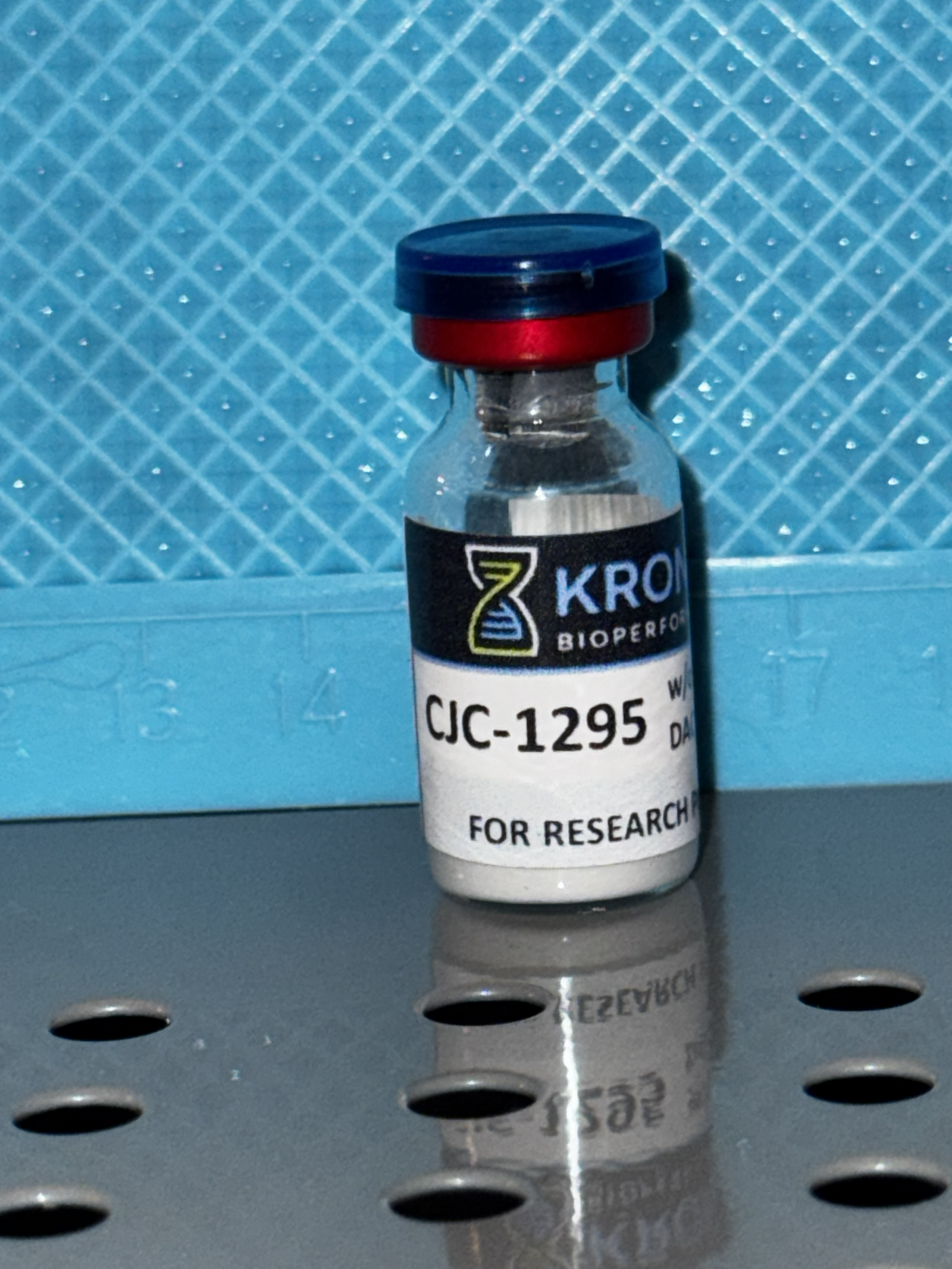
Description
For laboratory and scientific research only. Not for human consumption, veterinary use, or diagnostic purposes.
CJC-1295 is a synthetic growth hormone-releasing hormone (GHRH) analogue designed to increase growth hormone (GH) secretion by binding to GHRH receptors in the pituitary. It is available in two forms: CJC-1295 with DAC (Drug Affinity Complex) for prolonged half-life and CJC-1295 without DAC for shorter, more pulsatile GH release.
Researchers use CJC-1295 peptide to study GH/IGF-1 axis regulation, metabolism, and recovery pathways in preclinical models. Its ability to induce sustained GH release makes it an important tool in endocrine and metabolic research.
-
High Purity: ≥98% purity ensures reproducible experimental results.
-
Extended Half-Life: DAC version allows weekly dosing models.
-
Receptor Specificity: Targets GHRH receptors with precision.
-
Stability: Lyophilized form maintains potency during storage.
-
Versatile Options: Available with and without DAC for different study designs.
-
Batch Tested: Identity and purity verified for every lot.
Research Applications
Growth Hormone Secretion Studies
CJC-1295 is studied for its ability to increase pulsatile GH release and raise circulating IGF-1 levels over time [1].
Metabolism & Fat Oxidation
Research suggests CJC-1295 may enhance fat metabolism and improve body composition in animal models [2].
Anti-Aging and Regeneration
Preclinical research suggests CJC-1295 No DAC may help maintain tissue health and support cellular repair. Its effects on GH signaling have been investigated in aging models for possible roles in preserving muscle mass, supporting skin structure, and promoting recovery in various tissues. [3].
Gut Health and Intenstinal Research
Often studied in conjunction with GHRPs (e.g., Ipamorelin) to evaluate synergistic effects on GH secretion [4].
References
-
Teichman SL et al. (2006). Prolonged Stimulation of GH and IGF-1 with CJC-1295 in Healthy Adults. Journal of Clinical Endocrinology & Metabolism.
https://academic.oup.com/jcem/article-abstract/91/3/799/2843281 -
Mieritz, M. G. et al. (2009). Body composition and metabolic outcomes after GH analog administration. Hormone Research in Paediatrics, 72(2), 114–122. https://www.sciencedirect.com/science/article/pii/S1096637409000409
-
Lapira, J. et al. (2008). Age-related GHRH signaling and GH pulsatility. Journal of Neuroendocrinology, 20(9), 1012–1019.
https://onlinelibrary.wiley.com/doi/full/10.1111/j.1365-2826.2008.01740.x -
Mayo Clinic Staff. (2005). GH stimulation and GI regeneration: Preclinical overview. PubMed, PMID: 15817669.
https://pubmed.ncbi.nlm.nih.gov/15817669/

Reviews
There are no reviews yet.