
Description
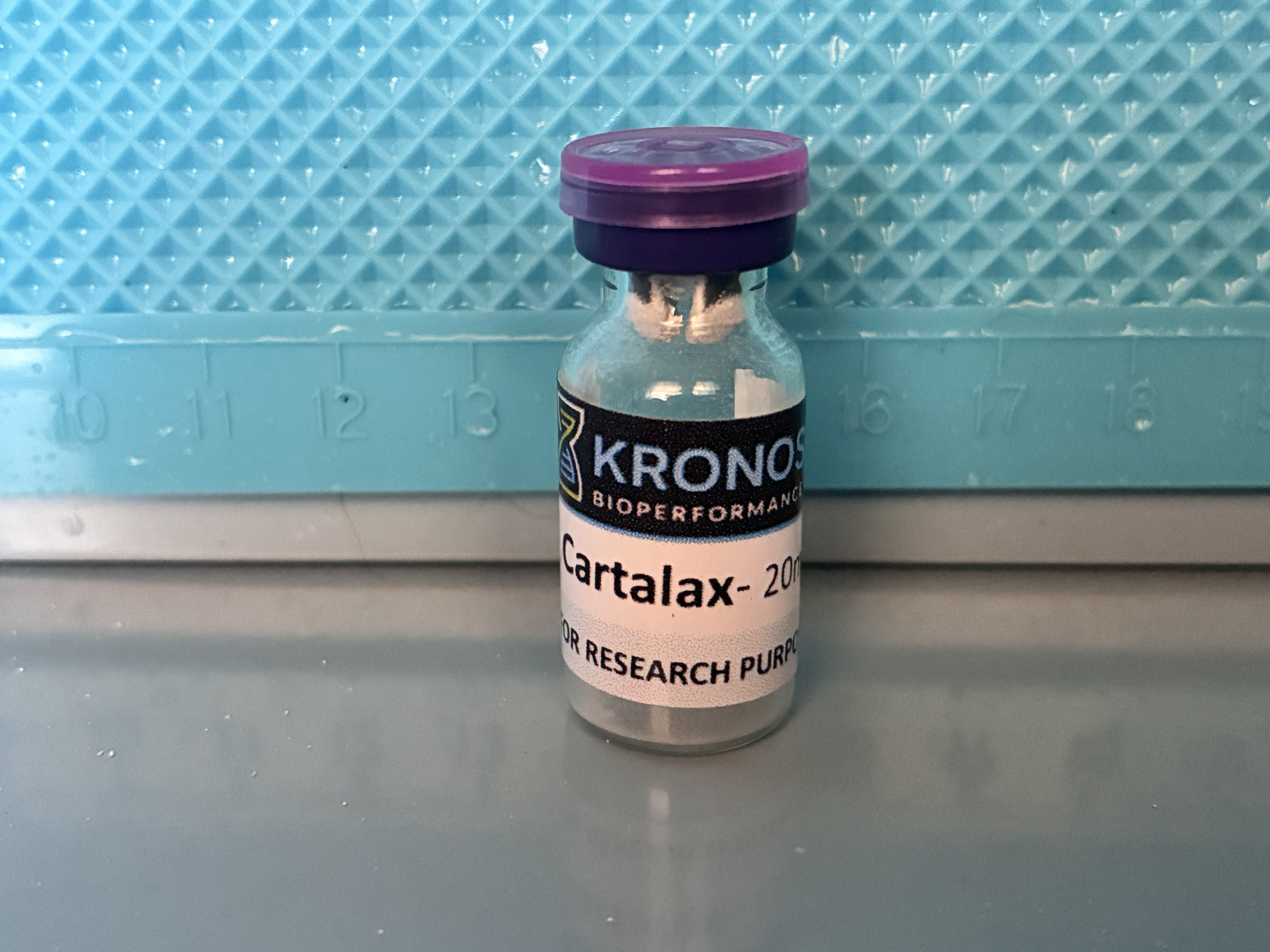
What Is Cartalax?
Cartalax is a short peptide bioregulator developed as part of the Russian cytamine (organ-specific peptide) research program, led by Dr. Vladimir Khavinson and colleagues. It is composed of cartilage-derived regulatory peptides designed to support the function and regeneration of cartilaginous and connective tissues.
Unlike systemic growth factors or hormones, Cartalax functions as a tissue-specific signaling peptide, intended to help restore age-related or stress-related declines in cartilage cell (chondrocyte) activity.
Cartalax is classified as a bioregulator, meaning it works by normalizing gene expression and cellular communication within a specific tissue rather than forcing growth or inflammation.
What Does Cartalax Do?
Cartalax is best known for its role in joint, cartilage, and connective tissue support. It has been studied for its ability to:
-
Support cartilage regeneration and maintenance
-
Improve joint resilience and mobility
-
Support connective tissue repair
-
Reduce age-related degeneration of cartilage
It is commonly discussed in longevity and orthopedic research contexts involving joint health, cartilage aging, and recovery from mechanical stress.
How Does Cartalax Function in the Body?
Cartalax exerts its effects through targeted cellular signaling mechanisms:
1. Chondrocyte Gene Regulation
Cartalax influences gene expression in cartilage cells, helping normalize protein synthesis involved in:
-
Collagen production
-
Proteoglycan synthesis
-
Extracellular matrix (ECM) integrity
2. Cartilage Tissue Homeostasis
By supporting balanced anabolic and catabolic activity in cartilage, Cartalax helps maintain healthy turnover and structure of joint tissues.
3. Anti-Degenerative Signaling
Cartalax helps counteract age-related declines in cartilage repair signaling, supporting long-term joint resilience rather than short-term symptom relief.
4. Tissue-Specific Action
As a bioregulator, Cartalax acts selectively in cartilage tissue, minimizing systemic effects and reducing the risk of overstimulation seen with broader anabolic compounds.
What Do Studies Show?
Preclinical and clinical research from Russian and Eastern European institutions suggests that Cartalax:
-
Supports cartilage cell metabolism and regeneration
-
Improves structural integrity of joint tissues in aging models
-
May slow progression of cartilage degeneration
-
Demonstrates good tolerability in long-term use
Most studies focus on functional outcomes, histological markers, and tissue regeneration indicators, rather than acute pain suppression.
Overall Benefits of Cartalax
-
Supports cartilage regeneration and maintenance
-
Promotes joint resilience and mobility
-
Helps counteract age-related cartilage degeneration
-
Supports connective tissue health at the cellular level
-
Tissue-specific action with favorable tolerability
Cartalax is often positioned as a foundational joint bioregulator, commonly evaluated alongside BPC-157, TB-500, or MOTS-c in musculoskeletal and longevity-focused research frameworks.
Important Regulatory Note
Cartalax is not FDA-approved for medical use in the United States and is sold as a research bioregulator only. This information is provided for educational and informational purposes and is not intended to diagnose, treat, cure, or prevent any disease.
References
- Liu Q. Functional peptides for cartilage repair and regeneration. Am J Transl Res. 2018;10(2):501–510. (NIH/PMC)
https://www.ncbi.nlm.nih.gov/pmc/articles/PMC5835815/ PMC - Mahzoon S, Detamore MS. Chondroinductive Peptides: Drawing Inspirations from Cell-Matrix Interactions. Tissue Eng Part B Rev. 2019;25(3):249–257. (PubMed / doi.org) PubMed
- Ajeeb B, et al. Chondroinductive Peptides for Cartilage Regeneration. Tissue Eng Part B Rev. 2022. (PubMed / doi.org) PubMed
- Zhu M, et al. Chondroinductive/chondroconductive peptides and their functionalized biomaterials. (NIH/PMC / ScienceDirect) PMC
- Kapat K, et al. Peptide-Based Biomaterials for Bone and Cartilage Regeneration. Biomedicines. 2024;12(2):313. (MDPI) MDPI
- Liao HJ, et al. Peptides for Targeting Chondrogenic Induction and Cartilage Regeneration. (NIH/PMC)
https://www.ncbi.nlm.nih.gov/pmc/articles/PMC11556548/ PMC - Xue S, et al. Cartilage-targeting peptide-modified dual-drug delivery nanoplatform for osteoarthritis therapy. J Control Release. 2021. (PubMed / nih.gov) PMC
- Morici L, et al. Cartilage-targeted drug nanocarriers for osteoarthritis therapy. J Controlled Release. 2024. (ScienceDirect) ScienceDirect
- Liu W, et al. Dual-engineered cartilage-targeting extracellular vesicles for enhanced osteoarthritis therapy. (NIH/PMC) PMC
- Ross A, et al. Peptide Biomaterials for Tissue Regeneration. Front Bioeng Biotechnol. 2022. (NIH/PMC / frontiersin.org) PMC
- Ripmeester EGJ, et al. The BMP7-Derived Peptide p[63–82] Reduces Cartilage Degeneration. (NIH/PMC) PMC
- Du Y, et al. A chondroinductive peptide sustained-release platform for cartilage regeneration. (ScienceDirect / doi.org; early access) ScienceDirect
Reviews
There are no reviews yet.