
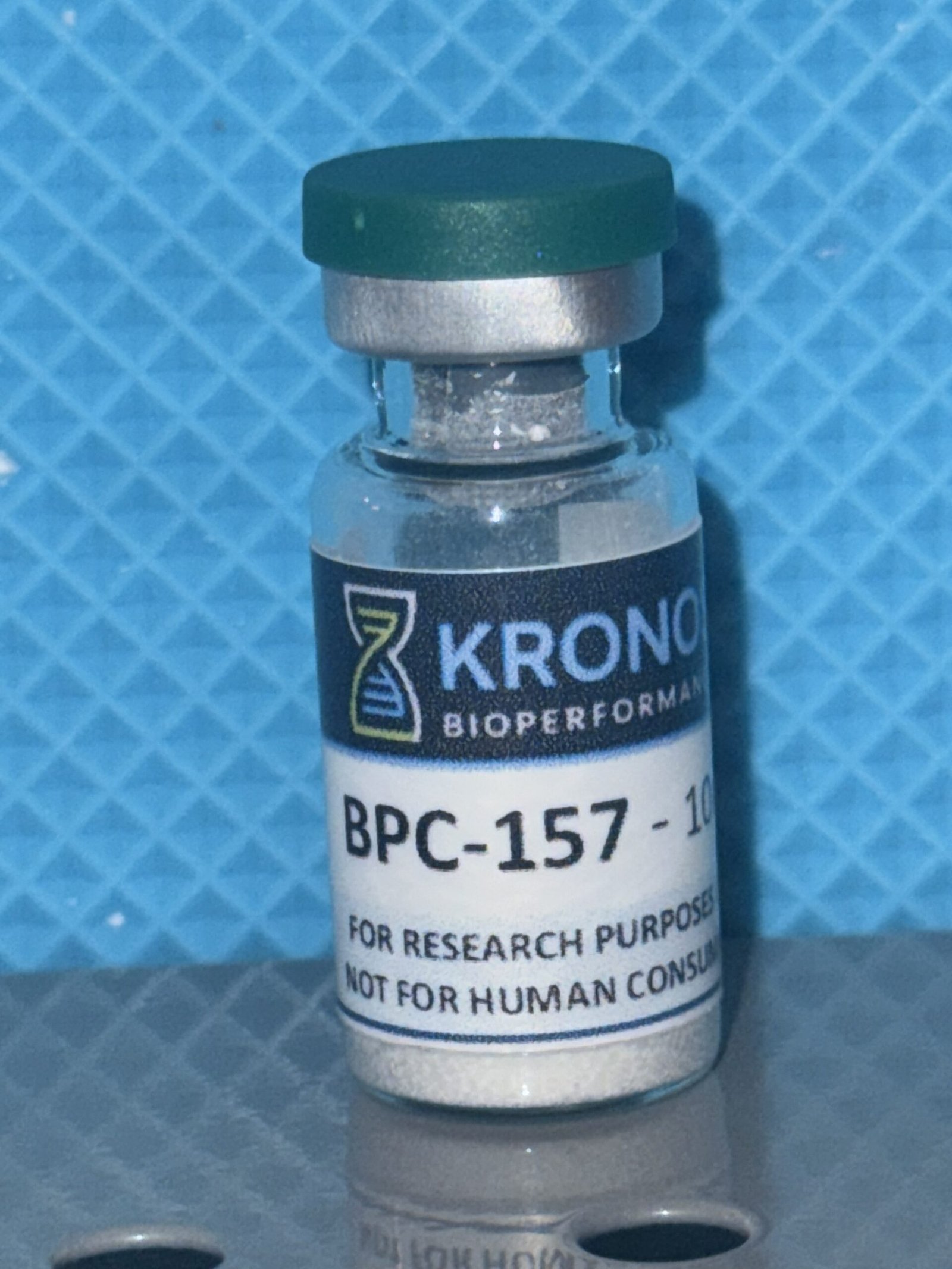
Description
What Is BPC-157?
BPC-157 is a synthetic pentadecapeptide (15 amino acids) derived from a naturally occurring protein found in human gastric juice, known as Body Protection Compound. It was first studied in the 1990s as part of gastrointestinal and tissue-repair research.
BPC-157 is unique among peptides because of its broad cytoprotective and regenerative signaling across multiple tissues. Rather than acting as a hormone or growth factor, it functions as a system-level repair peptide, influencing angiogenesis, cellular migration, and inflammatory signaling.
It is stable in gastric conditions and has been studied via oral, injectable, and local administration routes in research settings.
What Does BPC-157 Do?
BPC-157 is best known for its role in tissue repair, healing, and recovery. It has been studied for its ability to:
-
Accelerate healing of tendons, ligaments, and muscle
-
Support gastrointestinal lining repair and gut integrity
-
Promote angiogenesis (new blood vessel formation)
-
Reduce inflammation while supporting tissue regeneration
-
Support nerve repair and functional recovery
Because of its wide range of effects, BPC-157 is often discussed in orthopedic, gastrointestinal, and neuro-repair research.
How Does BPC-157 Function in the Body?
BPC-157 acts through multiple interconnected biological pathways:
1. Angiogenesis & Blood Flow Regulation
BPC-157 promotes the formation of new blood vessels and improves microcirculation by influencing VEGF and nitric oxide (NO) signaling, supporting oxygen and nutrient delivery to healing tissues.
2. Cellular Migration & Tissue Repair
It enhances fibroblast and endothelial cell migration, which are essential for tissue regeneration and structural repair.
3. Inflammatory Modulation
BPC-157 helps regulate inflammatory pathways by:
-
Reducing pro-inflammatory cytokines
-
Supporting balanced immune signaling rather than immune suppression
4. Gastrointestinal Cytoprotection
Originally studied in gastric tissue, BPC-157 protects and repairs the gut mucosal lining, helping restore barrier integrity and reduce inflammatory damage.
5. Neuroprotective Signaling
Research suggests BPC-157 supports nerve regeneration and protects neural tissue following injury.
What Do Studies Show?
Preclinical research indicates that BPC-157:
-
Accelerates healing of muscles, tendons, ligaments, and bone in animal models
-
Promotes angiogenesis and tissue regeneration
-
Protects gastrointestinal tissues from injury and inflammation
-
Supports nerve repair and functional recovery
-
Demonstrates a favorable safety profile across multiple administration routes
While human clinical trials are limited, the volume and consistency of preclinical data has made BPC-157 one of the most widely researched regenerative peptides.
Overall Benefits of BPC-157
-
Broad-spectrum tissue repair and regeneration
-
Supports tendon, ligament, muscle, and joint healing
-
Promotes angiogenesis and healthy blood flow
-
Supports gut health and barrier integrity
-
Modulates inflammation without immunosuppression
BPC-157 is often positioned as a foundational repair peptide, frequently stacked with TB-500, Thymosin Alpha-1, Cartalax, or GH-axis peptides in recovery-focused research protocols.
Important Regulatory Note
BPC-157 is not FDA-approved for medical use in the United States and is sold as a research peptide only. This information is provided for educational and informational purposes and is not intended to diagnose, treat, cure, or prevent any disease.
How BPC-157 Works)
-
Angiogenic Modulation: Stimulates VEGF and FAK-paxillin signaling pathways, enhancing blood vessel growth and revascularization in injured tissues [Sikiric 2018].
-
Cytoprotective Effects: Reduces oxidative stress and cellular damage, protecting gastric and other tissues from injury [Sikiric 2014].
-
Collagen Production Support: Promotes fibroblast migration and collagen synthesis, accelerating tendon and ligament healing [Vukojević 2017].
-
Anti-Inflammatory Role: Downregulates pro-inflammatory cytokines such as TNF-α and IL-6, contributing to faster recovery [Sikiric 2014].
-
Neuromodulatory Effects: Encourages axonal regeneration and supports synaptic repair in peripheral nerve injury models [Gwyer 2020].
-
References
-
Vukojević J et al. (2017). BPC 157 and Tendon Healing: Evidence from Animal Studies. Journal of Orthopaedic Research.
https://onlinelibrary.wiley.com/doi/10.1016/S0736-0266(03)00110-4 -
Sikiric P et al. (2018). Angiogenesis Effects of BPC-157 Peptide in Ischemic Models. Current Pharmaceutical Design.
https://link.springer.com/article/10.1007/s00109-016-1488-y -
Sikiric P et al. (2014). BPC-157 as a Novel Agent for GI Mucosal Protection. Current Pharmaceutical Design.
https://link.springer.com/article/10.1007/s10787-024-01499-8 -
Gwyer D et al. (2020). BPC-157 and Neural Repair Mechanisms in Preclinical Research. Neural Regeneration Research.
https://josr-online.biomedcentral.com/articles/10.1186/s13018-019-1242-6
-

Reviews
There are no reviews yet.